
NOVEMBER 6, 2026
Janitorial Scope of Work: What to Include, With a Template
A janitorial scope of work is the document that tells a cleaning contractor exactly what to clean, how often, to what standard and how the result will be checked. It is the part of a janitorial RFP or contract that bidders price from, and the part you will point to when something is missed. A vague scope (“clean offices nightly”) produces bids you cannot compare and service you cannot enforce.
This guide covers what to put in a cleaning scope of work, gives you a sample task frequency table to adapt, explains how APPA cleaning levels translate into staffing and cost, and lists the clauses that prevent most disputes. It is written for facility managers, office managers and procurement teams preparing a bid or renewing a contract.
In this guide:
- Scope of work, RFP and contract: what is the difference?
- What a janitorial scope of work should include
- Sample task frequency table
- Frequency-based or performance-based?
- Setting the standard with APPA cleaning levels
- Clauses that prevent most disputes
- Government contracts and the Service Contract Act
- Using the scope to compare bids
- Frequently asked questions
Scope of Work, RFP and Contract: What Is the Difference?
The request for proposal (RFP) is the bid package: instructions, deadlines, evaluation criteria and required forms. The scope of work (sometimes called janitorial specifications) is the technical heart of it, describing the building and the work. The contract is what you sign with the winning bidder, and the scope of work is normally attached to it as an exhibit. Write the scope once, carefully, and it does all three jobs: it lets bidders price, lets you compare and lets you hold the contractor to the result.
What a Janitorial Scope of Work Should Include
- Facility profile. Address, building hours, occupancy and cleanable square feet broken down by space type: carpeted offices, hard-floor areas, restrooms (with fixture counts), break rooms, lobbies, stairwells, and any labs or production areas. Bidders price from these numbers, so measure them rather than estimate.
- Service schedule. Days per week, start and finish times, whether you need a day porter, and which holidays are excluded.
- Tasks and frequencies by area. What gets done in each space, and how often. This is usually a table (see the sample below).
- The quality standard. What “clean” means, either in written acceptance criteria or by naming an APPA cleaning level for each area.
- Periodic and project work. Floor stripping and refinishing, carpet extraction, high dusting, interior and exterior glass. State whether each is included in the monthly price or quoted separately at a unit rate.
- Supplies and equipment. Who provides paper, liners, hand soap, chemicals and equipment, and any product requirements, such as cleaners certified to Green Seal GS-42 for green cleaning programs.
- Staffing, supervision and security. Background checks, badging, key and alarm control, a named supervisor, and required training, including OSHA hazard communication and, where workers may handle blood or sharps in restrooms, bloodborne pathogens training.
- Quality control and response times. How often the work is inspected, who scores it, how quickly complaints must be fixed and what happens when they are not.
- Insurance and compliance. Liability and workers’ compensation limits, site safety rules and any prequalification platform the contractor must be registered on, such as ISNetworld.
- Reporting and communication. A single point of contact, how issues are logged and how often you meet to review performance.
- Pricing format. A fixed monthly price for routine work, unit prices for periodic work and an hourly rate for extra requests, so every bid comes back in the same shape.
For labs, clean rooms and production areas, the scope should reference the site’s own procedures instead of generic tasks. Our guide to cleanroom cleaning procedures explains what those procedures cover.
Sample Task Frequency Table
Use this as a starting template for a typical office or mixed-use commercial building and adjust frequencies to your traffic and standards. “Daily” here means each scheduled service day.
| Area | Task | Frequency |
|---|---|---|
| Entrances and lobby | Clean entry glass, vacuum or damp-mop floors, clean walk-off mats | Daily |
| Offices and workstations | Empty trash and recycling, dust reachable surfaces, vacuum traffic lanes | Daily |
| Offices and workstations | Vacuum full carpet including edges, dust high-touch fixtures | Weekly |
| Conference rooms | Wipe tables and chairs, clean whiteboards, reset room, vacuum | Daily |
| Restrooms | Clean and disinfect fixtures, mirrors and partitions, restock, mop floors | Daily or every shift |
| Restrooms | Scrub floors and grout, descale fixtures, wash walls | Weekly to monthly |
| Break rooms and kitchens | Clean counters, sinks, tables, microwave exterior, mop floors | Daily |
| Break rooms and kitchens | Clean refrigerator and microwave interiors | Weekly |
| High-touch points | Disinfect door handles, switches, rails, elevator buttons | Daily |
| Hard floors | Machine scrub or burnish | Weekly to monthly |
| Hard floors | Strip and refinish | 1 to 2 times a year |
| Carpet | Hot-water extraction | Quarterly to annually |
| High dusting | Vents, ledges, light fixtures, tops of partitions | Monthly to quarterly |
| Interior glass | Partitions and door glass, full clean | Weekly |
| Exterior windows | Ground-floor or full exterior wash | Quarterly or as quoted |
For warehouses and distribution centers, the areas and frequencies change considerably; our warehouse cleaning checklist lists them.
Frequency-Based or Performance-Based?
A frequency-based scope lists tasks and how often they happen: vacuum offices daily, strip floors twice a year. It is easy to price and easy to check, but it can reward a contractor for doing the task on schedule even when the result is poor.
A performance-based scope defines the outcome instead: restrooms are clean, stocked and odor-free at every inspection, with no more than a set number of defects. The contractor decides how often each task needs doing. It encourages efficiency but is harder to price and needs a disciplined inspection program.
Most well-run contracts use both: frequencies for the minimum routine, and an outcome standard that inspections are scored against. If the standard is missed, the contractor fixes it at its own cost regardless of what the frequency table says.
Setting the Standard With APPA Cleaning Levels
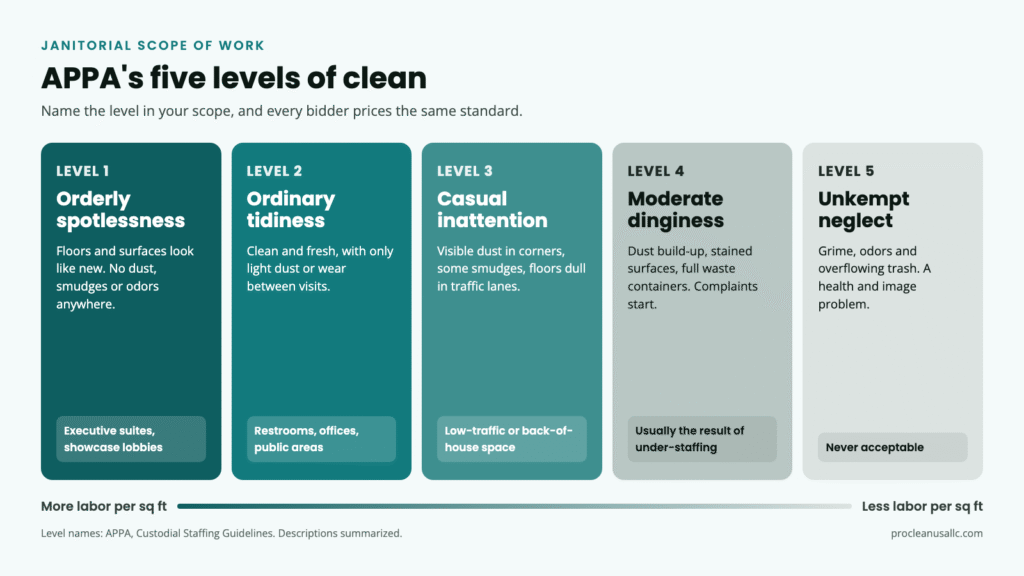
The most widely used way to define “clean” in a scope is the five-level scale from APPA, the facilities management association, published in its custodial staffing guidelines. It was written for colleges and universities but is now common in office, government and healthcare bids because it gives everyone the same vocabulary.
| Level | Name | What it looks like |
|---|---|---|
| 1 | Orderly spotlessness | Surfaces and floors look new; no dust, marks or odors |
| 2 | Ordinary tidiness | Clean and fresh, with only light dust or wear between visits |
| 3 | Casual inattention | Dust in corners, some smudges, dull floors in traffic lanes |
| 4 | Moderate dinginess | Dust build-up, stains, full waste containers, complaints |
| 5 | Unkempt neglect | Grime, odors and overflowing trash |
The level you choose drives cost more than any other line in the scope. In APPA’s staffing tables, a Level 4 standard lets one custodian cover more than twice the floor area of a Level 2 standard, which means roughly half the labor. Many buildings specify Level 2 for restrooms, lobbies and public areas and Level 3 for low-traffic back-of-house space. Restrooms and break rooms should not be specified below Level 2.
Whatever level you pick, make sure the labor in each bid can deliver it. A bid that prices Level 2 service with Level 4 labor hours will drift to Level 4 within a few months.
Clauses That Prevent Most Disputes
- Cleanable square footage, defined and attached as a floor plan or space list
- Change in scope: how added or removed space is priced, using the unit rates in the bid
- Supplies: who buys what, minimum stock levels, and who pays for overuse
- Re-clean window: deficiencies reported by a set time are corrected within 24 hours at no charge
- Access, keys and alarms: who is authorized, how keys are logged and what happens if an alarm is set off
- Damage and liability: reporting duty and responsibility for damage caused during cleaning
- Staffing continuity: notice before a supervisor or regular crew member is replaced
- Transition period: a 30-day start-up with extra inspections, and the outgoing contractor’s obligations
- Termination: for cause after documented, uncorrected deficiencies, and for convenience with notice
Government Contracts and the Service Contract Act
If the building is federal, the scope sits inside a contract governed by the McNamara-O’Hara Service Contract Act. Under 41 U.S.C. 6702, the Act covers federal and District of Columbia contracts over $2,500 whose principal purpose is furnishing services through service employees, which includes janitorial work. Contractors must pay at least the wages and fringe benefits in the wage determination for the county where the work is performed, published on SAM.gov.
For the agency, that means attaching the correct wage determination and making sure every bid prices labor at or above it. For bidders, it means the labor rate is set and competition happens on productivity, supervision and quality. ProClean USA works with governmental clients and builds its pricing for them on the required wage rates. Many state and local governments have their own prevailing wage or living wage rules, so check those before you publish a bid.
Using the Scope to Compare Bids
When every bidder prices the same scope in the same format, the comparison becomes straightforward. Look past the monthly total at:
- Labor hours per week, and the square feet per hour they imply. An outlier on the low side usually means the frequencies will not be met.
- Supervision: who inspects the work, how often, and whether a supervisor is on site.
- Supplies: whether consumables are included and which products are proposed.
- Periodic work pricing: unit rates for floors, carpets and windows, which is where low bids often recover their margin.
- References in similar buildings, and how long the bidder has kept comparable accounts.
Our guide on how to find the right custodial company covers vendor vetting in more detail, and janitorial vs. commercial cleaning explains which kind of service each part of your scope calls for.
Frequently Asked Questions
What is a janitorial scope of work?
It is the section of a cleaning RFP or contract that describes the facility, the cleaning tasks in each area, how often they are done, the quality standard, supplies, staffing and inspection. Bidders price from it and the contractor is held to it.
How detailed should a cleaning scope of work be?
Detailed enough that two bidders reading it would staff the building the same way. At minimum that means square footage by space type, fixture counts, a task frequency table, a defined quality standard and a clear split of who provides supplies.
Should the scope include cleaning supplies?
It should say who provides them either way. Many buildings have the contractor supply chemicals and equipment and either supply or bill for consumables such as paper and liners. Including them makes bids easier to compare and puts restocking on the contractor.
What is a good APPA level for an office building?
Level 2, ordinary tidiness, is the usual target for offices, restrooms and public areas. Level 1 is reserved for executive and showcase spaces, and Level 3 can work for low-traffic storage or back-of-house areas.
Can a cleaning company help write the scope?
Yes. A contractor’s walkthrough is a good way to measure the space and list the tasks, but keep control of the final standard and frequencies so the scope stays neutral for other bidders.
Get Help Building Your Scope
ProClean USA has priced and delivered janitorial programs for offices, industrial plants, distribution centers and governmental clients since 1996. We will walk your building, measure the cleanable space and turn it into a written scope with frequencies and a proposal you can compare like for like. See our janitorial services, office cleaning and commercial cleaning programs, or request a walkthrough. Call (856) 237-3041.
Recent Posts

Cleanroom Cleaning Procedures: A Step-by-Step Guide
Cleanroom cleaning procedures explained: the cleaning sequence, frequency by ISO class and GMP grade, disinfectant rotation and the records QA expects.
NOVEMBER 6, 2026
Janitorial vs. Commercial Cleaning: What’s the Difference?
Janitorial services handle daily upkeep. Commercial cleaning covers deep and specialty work. See what each includes and which one your facility needs.
OCTOBER 27, 2026
Warehouse Cleaning Checklist: Daily, Weekly and Quarterly Tasks
A warehouse cleaning checklist for distribution centers: daily, weekly and quarterly tasks, OSHA housekeeping basics and how to schedule around shifts.
OCTOBER 27, 2026

Why Hire a Commercial Cleaner for Post-Construction Cleanup
Post-construction cleanup is one of the most important steps in the building process, yet it is often overlooked by contractors and business owners. After the dust settles and the last nail is hammered in, your property may still be far from ready for its intended use. Dust, debris, leftover materials, and stains are just a […]
NOVEMBER 25, 2024

Why Philadelphia Businesses Rely on Custodial Services
Facility managers and decision-makers in large commercial businesses know that maintaining a clean and organized space is essential not only for the health and safety of employees but also for creating a positive impression on clients and customers. In a bustling city like Philadelphia, where businesses span a wide range of industries—from corporate offices to […]
NOVEMBER 16, 2024