NOVEMBER 6, 2026
Cleanroom Cleaning Procedures: A Step-by-Step Guide
Cleanroom cleaning procedures decide whether a controlled environment stays in specification between certifications. A room can pass its particle counts on qualification day and drift out of control within weeks if the people cleaning it use the wrong wipe, mop in circles or skip the sporicide. This guide walks through how a cleanroom is cleaned, step by step: who writes the procedure, the order of work, how often each surface is cleaned by ISO class and GMP grade, how disinfectants are rotated and what records your quality team should expect to see.
It is written for facility, EHS and QA managers who run pharmaceutical, biotech or medical device cleanrooms, and for anyone bringing in a contractor to clean them.
In this guide:
- Who writes the procedure, and who follows it
- Cleanroom grades and ISO classes at a glance
- Before you start: tools, agents and gowning
- The cleaning sequence, step by step
- How often should a cleanroom be cleaned?
- Disinfectant rotation and sporicides
- Documentation QA will ask for
- Common cleanroom cleaning mistakes
- Frequently asked questions
Who Writes the Procedure, and Who Follows It
In a regulated facility, cleaning is not left to the judgment of whoever holds the mop. For US drug manufacturers, 21 CFR 211.56 requires written procedures “assigning responsibility for sanitation and describing in sufficient detail the cleaning schedules, methods, equipment, and materials to be used,” and states that those procedures apply to work performed by contractors and temporary employees as well as full-time staff. The European rules for sterile products, EU GMP Annex 1, say cleanrooms should be “cleaned and disinfected thoroughly in accordance with a written programme” and that the disinfection process should be validated.
That sets a clear division of labor. The facility’s quality unit owns the standard operating procedure (SOP): it chooses and validates the cleaning and disinfecting agents, sets the frequencies and approves any change. The people who clean, whether employees or a contractor, follow that SOP exactly and document that they did. A cleaning contractor that offers to bring its own procedure into your classified areas is offering the wrong thing.
A note on standards: ISO 14644-13, the part of the cleanroom series that covers cleaning surfaces to defined levels of particle and chemical cleanliness, was reissued as a second edition in 2026 (IEST summary of ISO 14644-13). It helps you choose and evaluate cleaning methods, but it is not a ready-made SOP. The procedure for your rooms still has to be written around your process, your surfaces and your environmental monitoring data.
Cleanroom Grades and ISO Classes at a Glance
Cleaning intensity follows the classification of the room. Pharmaceutical facilities usually work with EU GMP grades A to D, while semiconductor, electronics and many medical device plants use the ISO 14644-1 classes directly. The table maps one to the other using the particle limits in Annex 1.
| GMP grade | At rest | In operation | Typical use |
|---|---|---|---|
| A | ISO 5 | ISO 5 | Critical zone: aseptic filling, open sterile product |
| B | ISO 5 | ISO 7 | Background room for Grade A work |
| C | ISO 7 | ISO 8 | Less critical steps, such as solution preparation |
| D | ISO 8 | Set by the manufacturer | Component handling, support and transfer rooms |
Most contract cleaning in life sciences buildings happens in Grade C and D (ISO 7 and 8) rooms, corridors, airlocks and the offices and support spaces around them. Grade A and B aseptic cores require gowning qualification and are often cleaned by the manufacturer’s own trained operators.
Before You Start: Tools, Agents and Gowning
Most cleanroom contamination problems trace back to what was carried into the room, not what was done inside it.
- Low-linting tools only. Cleanroom-compatible wipes (typically polyester knit or microfiber), mop heads and handles made for controlled environments. No cotton rags, paper towels, cardboard or standard janitorial carts.
- Dedicated, color-coded equipment. Tools used in a classified area stay in that area or follow a defined decontamination route. Tools from restrooms and general areas never enter.
- Approved agents, labeled and in date. Annex 1 expects disinfectants and detergents used in Grade A and B areas to be sterile, and prepared dilutions to be stored only for a defined period. Every container should show what it is, when it was prepared and when it expires.
- A multi-bucket system. Separate buckets for clean solution and for wringing or rinsing, so a used mop never goes back into clean solution. Many SOPs use a third bucket for waste.
- Gowning for the grade. Annex 1 states that all personnel, “including those performing cleaning,” should receive regular training, gowning qualification and assessment. Crew members gown exactly as operators do for the same room.
The Cleaning Sequence, Step by Step
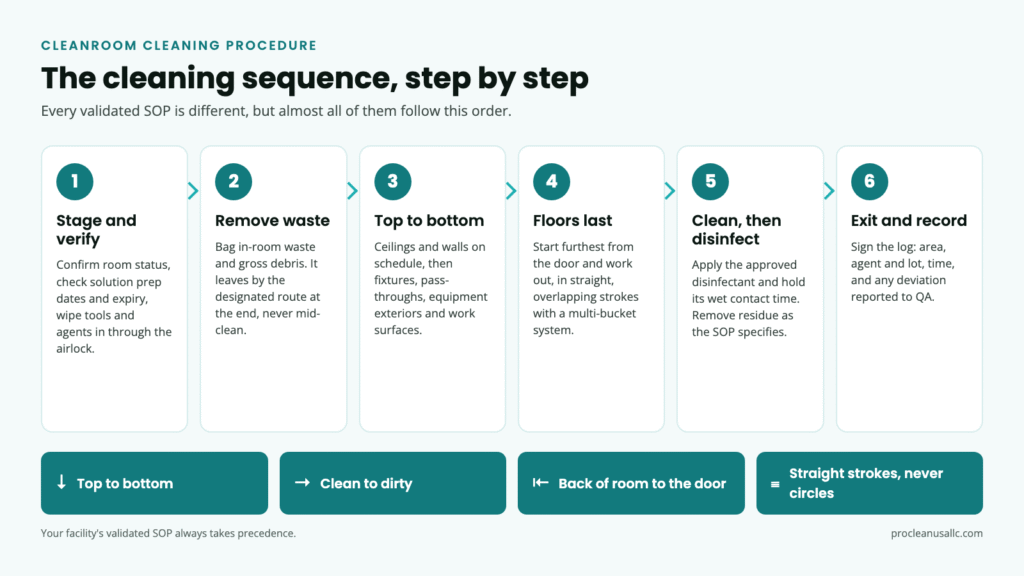
Every validated SOP is different, but almost all follow the same logic: work from cleaner to dirtier areas, from high surfaces to low ones, and from the back of the room toward the exit, so nothing you have already cleaned gets recontaminated.
- Stage and verify. Confirm the room’s status with production, check the prep date and expiry of every solution, and wipe down tools and containers as they pass through the airlock or pass-through.
- Remove waste and gross debris. Bag in-room waste and pick up visible debris first. Waste leaves by the designated route at the end of the clean, not halfway through.
- Clean from top to bottom. Ceilings and walls on their scheduled days, then light fixtures, door frames and pass-through interiors, then equipment exteriors and work surfaces. Never spray or wipe the face of a HEPA filter.
- Use straight, overlapping strokes. Wipe in one direction with each stroke overlapping the last, and fold the wipe to a clean face after each pass or surface. Circular scrubbing just moves particles around.
- Clean floors last. Start at the point furthest from the door and work back toward the exit in sections, rinsing or changing the mop head as the SOP specifies.
- Clean, then disinfect. Annex 1 notes that disinfection only works on a surface that has first been cleaned. Apply the disinfectant and leave it wet for its full contact time.
- Remove residues on schedule. Disinfectant build-up leaves sticky, particle-holding films. Annex 1 says cleaning programmes should remove those residues, often with a sterile water or 70% isopropyl alcohol wipe, as your SOP defines.
- Exit and record. Sign the log for the room before leaving the area, and report anything unusual (spills, damaged surfaces, missed areas) to the supervisor and QA.
How Often Should a Cleanroom Be Cleaned?
Frequency depends on classification, occupancy, the process inside the room and the trend in your environmental monitoring data. The table shows typical starting points used across the industry. Your validated SOP overrides it wherever they differ.
| Surface | ISO 5 / Grade A–B | ISO 7 / Grade C | ISO 8 / Grade D |
|---|---|---|---|
| Work surfaces and equipment exteriors | Before and after each use or shift | Each shift or daily | Daily |
| Floors | Each shift or daily | Daily | Daily |
| Pass-throughs and airlocks | Each transfer or shift | Daily | Daily |
| Walls and doors | Daily to weekly | Weekly | Weekly to monthly |
| Ceilings | Weekly to monthly | Monthly | Monthly to quarterly |
| Sporicidal application | Weekly or per SOP | Weekly to monthly | Monthly or per SOP |
Adverse monitoring results, a shutdown, construction work or a maintenance intervention all call for an extra clean before the room returns to use, whatever the routine schedule says.
Disinfectant Rotation and Sporicides
Both the US and EU regulators expect more than one disinfecting agent. Annex 1 says “more than one type of disinfecting agent should be employed” so that agents with different modes of action are effective against bacteria and fungi together, and that “disinfection should include the periodic use of a sporicidal agent.” The FDA guidance on sterile drug products produced by aseptic processing makes the same point more bluntly: many common disinfectants do not kill spores, and 70 percent isopropyl alcohol is ineffective against Bacillus spores, so a sound program includes a sporicidal agent used on a written schedule and whenever monitoring suggests spore-forming organisms.
In practice, most programs look like this:
- A broad-spectrum disinfectant for routine daily or per-shift cleaning
- A sporicide (commonly a hydrogen peroxide, peracetic acid or chlorine-based product) applied on a fixed schedule, plus after excursions or shutdowns
- A residue-removal step, because sporicides in particular are aggressive on stainless steel, vinyl and epoxy surfaces
- Monitoring data reviewed by QA to confirm the program works and to catch changes in the organisms being recovered
The FDA guidance also asks that disinfection procedures be described “in sufficient detail (e.g., preparation, work sequence, contact time) to enable reproducibility.” If a crew member could not repeat your procedure the same way from the written SOP alone, it needs more detail.
Documentation QA Will Ask For
If it was not written down, an auditor will treat it as not done. A complete cleaning record set includes:
- A cleaning log for each room or zone, signed per task and per shift
- The agent used, its lot number or preparation date, and confirmation of contact time where required
- Records of solution preparation and expiry
- Training and gowning qualification records for every person who cleans a classified area
- Supervisor inspections and any deviation, missed task or damage report, with what was done about it
- Change control for any change to agents, tools or frequencies
Logs should be completed in the format your quality system already uses, so QA reviews one record set rather than reconciling a contractor’s paperwork with your own.
Common Cleanroom Cleaning Mistakes
- Bringing standard janitorial tools, cotton cloths or cardboard packaging into classified areas
- Scrubbing in circles instead of straight, overlapping strokes
- Dipping a used mop back into clean solution in a single-bucket setup
- Wiping a disinfectant dry before its contact time has elapsed
- Using one wipe across several surfaces instead of folding to a clean face or replacing it
- Letting disinfectant residue build up until floors turn tacky and hold particles
- Spraying directly onto HEPA filter faces or close to open product
- Rotating untrained or ungowned temporary staff into controlled areas
In-House Team or Cleaning Contractor?
Many manufacturers keep Grade A and B cleaning with their own aseptic operators and contract out Grade C and D rooms, corridors, gowning rooms and the general areas of the building. What matters is that a contractor works to your SOPs, trains its people on them before they enter controlled areas, keeps the same crew on site and completes records QA can accept.
That is how ProClean USA approaches life sciences and biotech cleaning. We review your procedures and gowning requirements during the walkthrough, train crew members on them before service starts and put a Supervisor or Account Manager in charge of each account. We use the agents your facility approves, at your dilutions and contact times, and complete logs in your format. We do not certify GMP compliance or guarantee sterility; your quality unit owns those. For the rest of the building, our janitorial services cover offices, restrooms, break rooms and locker rooms on a standard program. If you are putting the work out to bid, our guide to writing a janitorial scope of work shows how to specify controlled areas alongside general cleaning.
Frequently Asked Questions
What is the correct order for cleaning a cleanroom?
Top to bottom, clean to dirty and back of the room to the door. Ceilings and walls come first on their scheduled days, then fixtures, equipment and work surfaces, and floors last, starting furthest from the exit. Surfaces are cleaned before they are disinfected.
How often should a cleanroom be cleaned?
Work surfaces and floors in ISO 5 to ISO 8 rooms are typically cleaned every shift or every day, walls weekly to monthly and ceilings monthly to quarterly, with a sporicide applied on a fixed schedule. The validated SOP and environmental monitoring results set the actual frequency.
Why do cleanrooms rotate disinfectants?
No single routine disinfectant kills everything. Regulators expect at least two agents with different modes of action, including a periodic sporicide, because common disinfectants such as 70% isopropyl alcohol do not kill bacterial spores.
Can a commercial cleaning company clean a cleanroom?
Yes, if its crews are trained on your SOPs and gowning, use your approved agents and tools, and document the work in your quality system. Most contractors work in ISO 7 and ISO 8 (Grade C and D) areas; aseptic Grade A and B work requires additional qualification and is agreed case by case.
Talk to Us About Your Controlled Areas
ProClean USA has cleaned complex industrial and regulated sites since 1996. Tell us what your facility makes, which areas are classified and how your current program is set up. We will walk the site with your facilities and quality contacts, review your procedures and send a written proposal with scope, frequency and cost. Request a walkthrough or call (856) 237-3041.
Recent Posts
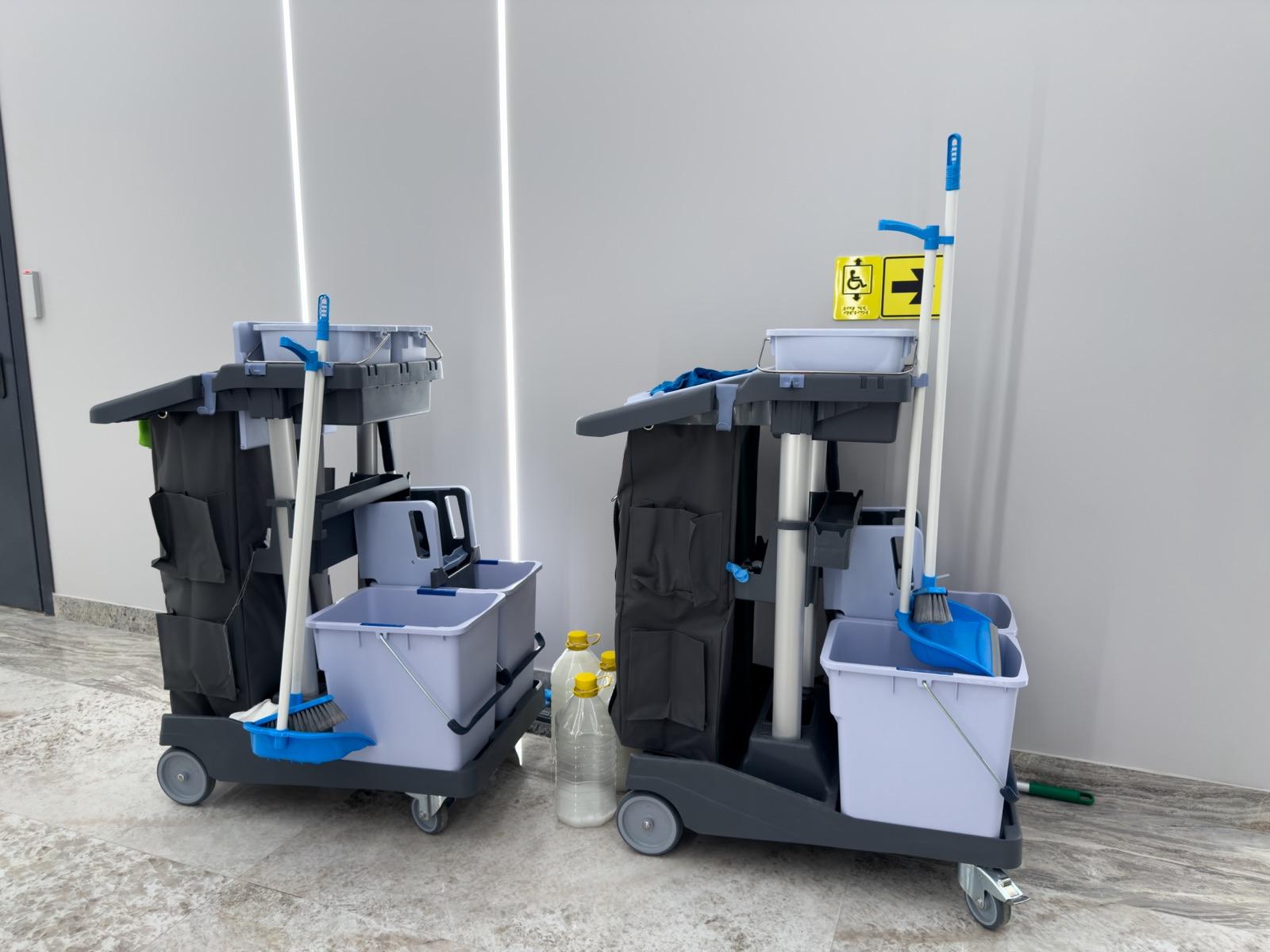
Janitorial Scope of Work: What to Include, With a Template
How to write a janitorial scope of work: areas, task frequencies, APPA cleaning levels, supplies, staffing, inspections and a sample frequency table.
NOVEMBER 6, 2026
Janitorial vs. Commercial Cleaning: What’s the Difference?
Janitorial services handle daily upkeep. Commercial cleaning covers deep and specialty work. See what each includes and which one your facility needs.
OCTOBER 27, 2026
Warehouse Cleaning Checklist: Daily, Weekly and Quarterly Tasks
A warehouse cleaning checklist for distribution centers: daily, weekly and quarterly tasks, OSHA housekeeping basics and how to schedule around shifts.
OCTOBER 27, 2026

Why Hire a Commercial Cleaner for Post-Construction Cleanup
Post-construction cleanup is one of the most important steps in the building process, yet it is often overlooked by contractors and business owners. After the dust settles and the last nail is hammered in, your property may still be far from ready for its intended use. Dust, debris, leftover materials, and stains are just a […]
NOVEMBER 25, 2024

Why Philadelphia Businesses Rely on Custodial Services
Facility managers and decision-makers in large commercial businesses know that maintaining a clean and organized space is essential not only for the health and safety of employees but also for creating a positive impression on clients and customers. In a bustling city like Philadelphia, where businesses span a wide range of industries—from corporate offices to […]
NOVEMBER 16, 2024